Thursday, September 24, 2020

Implementing TBM & ITSM processes in ServiceNow

 You spend a lot of time working with the top businesses in the energy sector and beyond in our consulting practice. Although we have historically concentrated predominantly on business solutions, we are now beginning to spend as much time on how our clients implement IT as on what solution is in delivery. IT is getting more difficult is the reason for this shift in emphasis. Without radically affecting how our customers do IT, we will not introduce today's IAAS, PAAS, Cloud and IoT based solutions that our customers urgently need. But, in this brave new world of IT, the old ways of doing things will not fit well.

As a result of collaborating with many customers to introduce advanced IT initiatives such as networks for energy trading, energy management systems and smart grid applications, we have also used a new IT model for these initiatives. We have been helping our clients to understand that it is also an opportunity to turn IT to incorporate vital solutions. In a nutshell, IT is not set up for success in big, high-risk, complex ventures in most organizations. We need to help turn them for our clients to thrive,More info go through servicenow course

Realignment of resources in ServiceNow

In certain instances, to concentrate and specialize in certain tasks, we recommend that performance involves a re-alignment of Its resources. More precisely, the vertical application domains are structured around business functions and are more oriented and focused on providing their customer organisations with direct application services, with less concern for those activities covered by the PAAS and IAAS.

In comparison, with a renewed "customer" emphasis on their application domains within the overall enterprise, the PAAS and IAAS resources will be concentrated on their respective technology areas. For instance, as customers with a customer service approach, a resource assigned to the PAAS in database management support would approach analysts and developers within vertical application domains. This is aligned with the best practises in today's IT industry and is a suitable model to be followed in the future.

With an emphasis on best practises focused on the notion of service management, the IT industry is rapidly maturing. A growing emphasis on efficient service delivery to the final customer is at the centre of this progression towards service management. For our traditional larger client, the recommendations are to reorganise the IT services based on the following Business & Service requirements. So what are the main norms that all our clients suggest to embrace?

Management of IT Operation in ITSM ServiceNow

IT service management (ITSM) applies to the entirety of operations. You can carry it out by a company to plan, design, produce, operate and check ( IT ) services. Then it provides customers, guided by regulations, coordinate and configure processes. Besides, it also includes supporting procedures. Thus, the delivery of IT services that meet the needs of customers. Then the IT service provider conducts it through an acceptable combination of individuals. IT service management, unlike more technology-oriented IT management. Thus, it approaches such as network management and IT systems management.

ITIL in ServiceNow

ITIL, formally an acronym for Library of Infrastructure of Information Technology. It is a collection of IT Service Management (ITSM) activities. It concentrates on aligning IT services with business needs. ITIL is in its current form (known as ITIL V3) as a collection of five core volumes. Thus, each covering a different lifecycle stage of the ITSM.

TBM-Technology Business Management in ServiceNow

It provides a paradigm shift in business. Thus, business leaders and a system for IT executives to have conversations about IT. This is with the CEO and the board of directors." Moreover, it provides a good business experience.

TOGAF & Archimate in ServiceNow

It is an enterprise architecture framework in ServiceNow. It offers an approach to the design, planning, implementation. Then the management of an enterprise information technology architecture. ArchiMate (/—r.k-met / ar-ki-may) is an open and independent language. This is for modelling enterprise architecture to support the description. Besides, it has analysis and visualization of architecture. ArchiMate is an Open Group technical standard that is on the principles of the standard. Different tool suppliers and consulting firms endorse it.

Adopt a Service Management Platform focus on standards. Then match this with the introduction of the latest IT model.'

· To succeed, IT requires its service management ERP. The efficient execution of an ITSM relies on the execution of an ERP framework. This is for the Service Management Platform.

· ServiceNow is the de-facto mainstream service management (CSM) platform. It is an efficient suite of software for information technology and service management.

· Performance in introducing a transition to successful IT business and service management. This depends on the proper setup and configuration of the platform of ServiceNow.

Standard-based Architect IT Company & Services Model in ServiceNow ITSM

· Companies need to take the time to adapt to the IT business model to their needs. You will explain what the model might look like at a high level to assist. This is with the more specific suggestions in the following sections.

· Using the TBM reference guide, the recommended standards-based model is below.
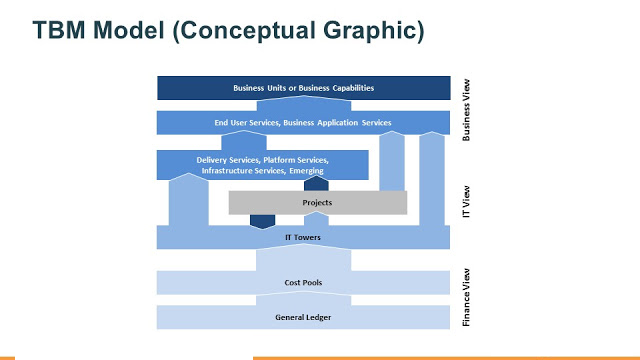
· Different views reflect the three levels of the taxonomy. The model begins with the Finance layer as the taxonomy's basis.

Finance in ServiceNow ITSM

With the general ledger, the lowest layer continues. But can include other expense sources specific to the company. A common collection of pools is for hardware, software, internal and external labour. Besides, the facilities and electricity, external services and others. Cost pools not only simplify cost allocations, they boost reporting. Besides, they can track through the model to expose cost composition. Then it allows composition comparability.

IT in ServiceNow ITSM

A common range of IT towers and sub-towers. These include such as servers, storage, voice and data networks, application creation. Then you can include support in the middle layer. These are prevalent in almost all businesses. Then the basic building blocks of particular software, facilities, and so on. Although the concepts of towers are traditional, they come in several types. They can internally and externally source. Thus, external service, external labour, or as a combination of the two. Besides, this view makes IT leaders determine the cost-effectiveness of IT software.

We define the following business capabilities for a traditional electrical utility, for instance.

· The generation

· Transmission etc.

Divisions in ServiceNow ITSM

We expect that the business divisions are fair and independent of each other. Then the focus should be on the areas of the company that generate value. As a consequence, organizational roles do not include such as HR, Accounting, Legal. Besides, as a central focus but should, if you consider it appropriate. The structure is a separate capability. This is a central argument in itself. IT should concentrate on how it can help the company's main capabilities first. Although finance and accounting are critical of TBM & ITIL is to align where IT is most required.

This principle of aligning with the strengths of the industry show above. Thus, these skills would also be compatible with business applications. For example, if power generation and energy trading are a key capability. It is also important to arrange application services to support them.

Conclusion

I hope you reach to a conclusion about TBM & ITSM processes. You can learn more through servicenow online training india

Wednesday, September 23, 2020

What is ServiceNow? — Getting Started with the ServiceNow Platform

 The IT sector today aims to achieve optimal efficiency. However, this is not an easy task as they face many roadblocks on the way. Legacy systems are still in use, which can slow them down considerably. In this article, I’ll be going into how ServiceNow came into existence in the ITSM sector, as well as how it’s grown to become a full-fledged enterprise cloud solution.

To learn complete course vistit:servicenow online training


We will discuss the following topics:

  • Why ServiceNow?
  • What Is ServiceNow?
  • ServiceNow Architecture
  • ServiceNow Applications
  • Creating A Personal Developer Instance

Let us begin this article by first understanding why ServiceNow?

Why ServiceNow?

ServiceNow had its roots set in ITSM since 2012. However, with changing technology and the advent of cloud, it created its niche as a cross-departmental platform which functions as an enterprise cloud solution which is built on top of all other applications. Its ability to create workflows which automate the process of data extraction makes it a unique offering in today’s cloud space.

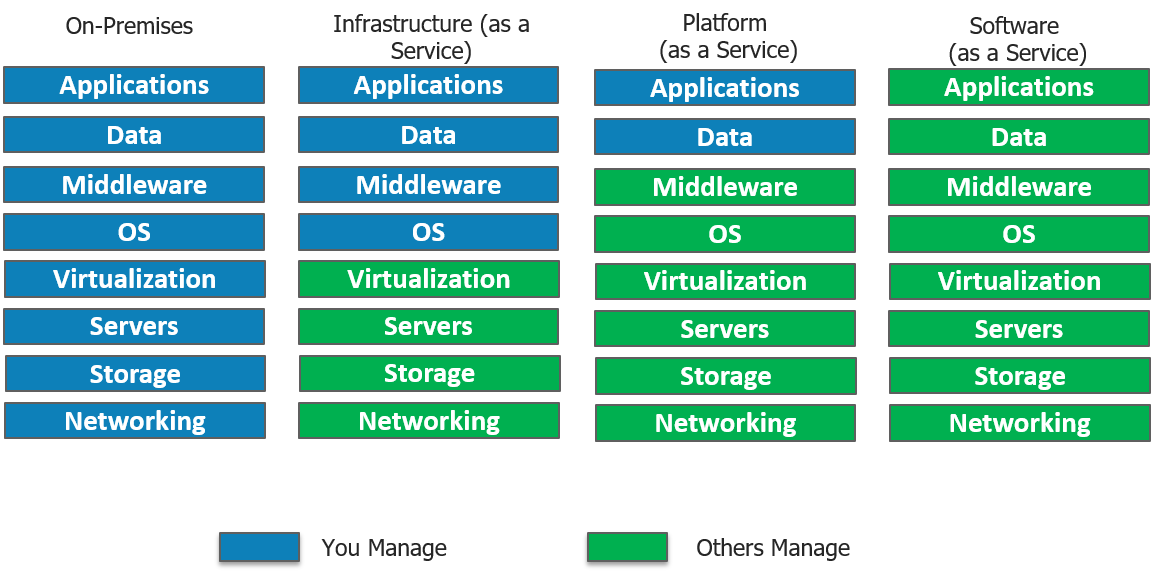
ServiceNow has a raving customer base which returns to its platform each year. Let’s now look at the different cloud deployment models and where ServiceNow fits in.

Image for post
Iaas, Paas and Saas — What is ServiceNow?

IaaS(Infrastructure as a service)

  • In short, IaaS gives you a server in the cloud(virtual machine) that you have complete control over.
  • In Iaas, you are responsible for managing everything from the Operating System on up to the application you are running.

PaaS(Platform as a Service)

  • With PaaS, you have a combination of flexibility and simplicity.
  • Flexible because it can be tailored to the application’s needs.
  • Simple as no need of OS maintenance, versions, patches.

SaaS(Software as a Service)

  • A software distribution model in which a third-party provider hosts applications.
  • Instead of installing and maintaining software, you simply access it via the Internet.
  • Automatic updates reduce the burden on in-house IT staff.

Where does ServiceNow fit in?

ServiceNow which started off on a SaaS model catering to ITSM, has also ventured into PaaS cloud model, in which the entire organization’s business processes can be managed by a single system of record. ServiceNow provides the infrastructure needed to perform data collection, storage, as well as application development all on a single platform. Although ServiceNow does not provide an in-house Iaas deployment model it does support integration to Microsoft Azure which is an IaaS model.

It offers configuration management database (CMDB) along with service mapping which powers service-aware applications. Service mapping shows the dependencies amongst the organization’s assets. This leads to much-needed visibility into the business environment.

Great, now let us try to address the most essential question of this article, what is ServiceNow?

What Is ServiceNow?

ServiceNow was founded in 2004 and stepped foot in the ITSM (Information Technology Service Management) field and provided competition to established players like IBM and HP. Today it is not just limited to ITSM, even though it still forms a major part of its revenue. Now, it is has diversified into 5 major services which include IT, Security, HR Service Delivery, Customer Service and Business Applications. ServiceNow is an integrated cloud solution which combines all these services in a single system of record.

ServiceNow’s Vice President Dominic Phillips, in one of his keynotes, pointed out that while we are witnessing so much “disruption” in the consumer sector, there is a lack of efficiency in internal business workflows inside organizations.

In today’s digital era, the ease of access that Uber and Airbnb provide while booking a cab or reserving a table is the kind of experience ServiceNow wants to provide to its customers within the enterprise.

Let us now move forward to understand how ServiceNow works by looking at its architecture.

ServiceNow Architecture

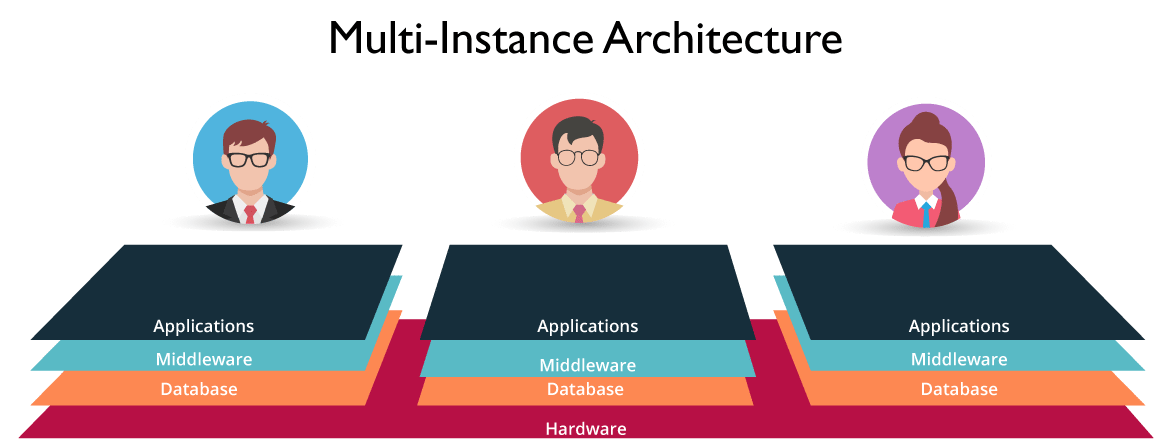
The majority of cloud service offerings today, run on the age-old Multi-tenant architecture like AWS, Azure, Salesforce, Oracle, etc. The Multi-tenant architecture creates a single instance which serves multiple customers. This usually deals with complex databases which demand frequent maintenance, often leading to unavailability of resources to customers. This is why ServiceNow has adopted a Multi-instance architecture.

Multi-instance architecture:

A unique instance is created for each employee which maintains a separate resource stack. This gives us the freedom to deal with each user’s specific needs, enabling us to deal on a customer-customer basis. E.g. customer upgrades can be deployed with respect to compliance requirements as well as the enterprise’s current needs.

In our diagram shown below, 3 customers have unique instances each with an isolated pool of resources. What this means is, while the hardware is shared, the software: Application, Middleware and Database are all separately maintained. Data Isolation is a huge advantage. This is why the performance of one customer is not influenced by another customers instance. Neat, isn’t it?

Image for post
Multi-Instance Architecture — What is ServiceNow?

ServiceNow Applications

Next, in this article, let’s get an overview of the ServiceNow Applications.

IT Service Desk

A report found that 15 hrs out of 45 hrs in a work week are spent doing non-work related tasks. It was identified that this is due to the outdated ITSM software in use.

In ServiceNow, employees are provided with a self-service portal where they can avail IT Services by messaging the concerned department staff. ServiceNow was able to bring the ease of use of social media apps to the ITSM sector which was still lagging behind with legacy systems.

With ConnectChat, the staff can reply in real time. This can be seen as an improvement over the traditional mailing system where messages had to be sent back and forth. This supports the sharing of files across departments. An employee can attach incident files as part of the conversation enabling technicians who can then directly look up the incident records and service the request. If a user is unsure which technician is on duty he can create a group with all technicians as members. Visual taskboards allow you to assign tasks to different departments with just a drag and drop gesture.

Resolving Security Threats

In spite of having a sophisticated security management mechanism in place for threat detection, when there is a security breach, most companies face an uphill task of resolving the problem.

ServiceNow uses structured workflows which helps prioritize risks based on their severity and their impact on the organization.

Threat research would normally take up to 45 minutes using spreadsheets and manual processing.

However, automated tools provide this information inside the platform which reduces the time involved to under 20 seconds.

HR Service Delivery

Ever wondered how HR spends most of its time doing repetitive tasks like employee onboarding when they should actually be focusing on strategic tasks instead?

ServiceNow wants to do away with all that manual processing. These tasks span across different departments like IT, Facilities, Legal and Finance. ServiceNow’s single platform can be used to connect HR workflows with all these departments. Decision making is made easy with its tracking and trending tools. HR is now powered with consumer-like customizable forms to deliver satisfactory service to employees.

Customer Service

The need of the hour is to provide uninterrupted quality service yet keeping the cost constraint in mind. ServiceNow is transforming Customer Service into a Team Sport. Unlike CRM(Customer Relationship Management) which is limited to customer engagement, ServiceNow Customer Service Management (CSM) operates by Connecting the right people, systems and workflows.

Customer Service is not limited to just resolving customer tickets. Whenever a customer is facing an issue, we need to find its root cause. This will reduce case(tickets) volume in the long run. ServiceNow comes with Service Mapping which provides cross-functional information to discover the initial point where the error was first noticed.

ServiceNow makes it easy to dispatch across different departments like engineering, field services, legal, etc. Take the example of the coffee maker that’s not working. The field agent is notified of its possible problem even before he starts his conversation with the customer. The customer is notified proactively with real-time notifications ensuring customer satisfaction and resolving issues at lightspeed.

Business Applications

ServiceNow comes with a drag and drop approach which allows you to customize Business Apps without writing a single line of code. For the experienced developer, you will never have to start from scratch again as you can choose from reusable components, workflows and link barriers across departments using information from the cloud.

Let’s now move ahead in this article and understand what is a PDI.

Personal Developer Instances (PDI)

PDIs are meant for a walkthrough of the ServiceNow features. It can be used by developers, customers or even partners. The motive behind this instance is, it does not interfere with the production instance. Application ideas can be tested on PDI’s however, it will not be added to the final application repository.

Instances may be kept as long as there is regular activity. To be considered as active you need to either create applications or write scripts within 14 days. Now that we are aware of PDI’s, let’s move ahead and explore the ServiceNow Platform.

Creating A Personal Developer Instance(PDI)

To request a personal developer instance, the ServiceNow developer program provides you with a fully-functional instance, sized for single developer use. Let’s explore the two options to request a personal developer instance.

Step1: Log into the developer site at https://developer.servicenow.com.

Image for post

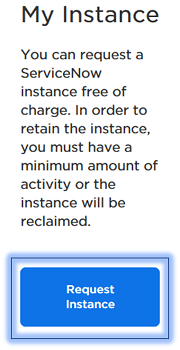
Step2: Request a PDI by doing any of the following actions.

  • From the dashboard homepage, click Request Instance.

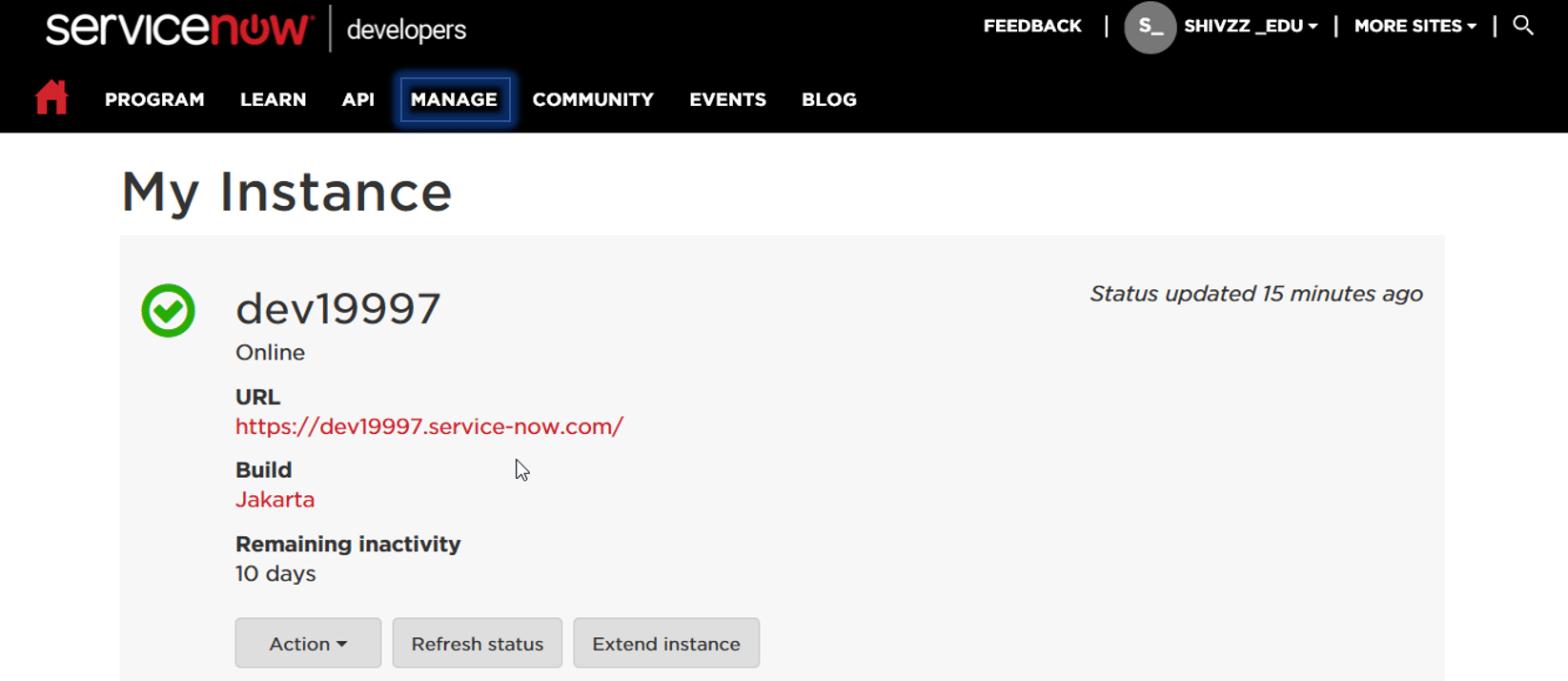
From any page on the developer site, navigate to Manage >> Instance and click Request Instance.

Image for post

On successful registration, you will get an instance copy as shown above. You can click on the URL and login with your credentials.

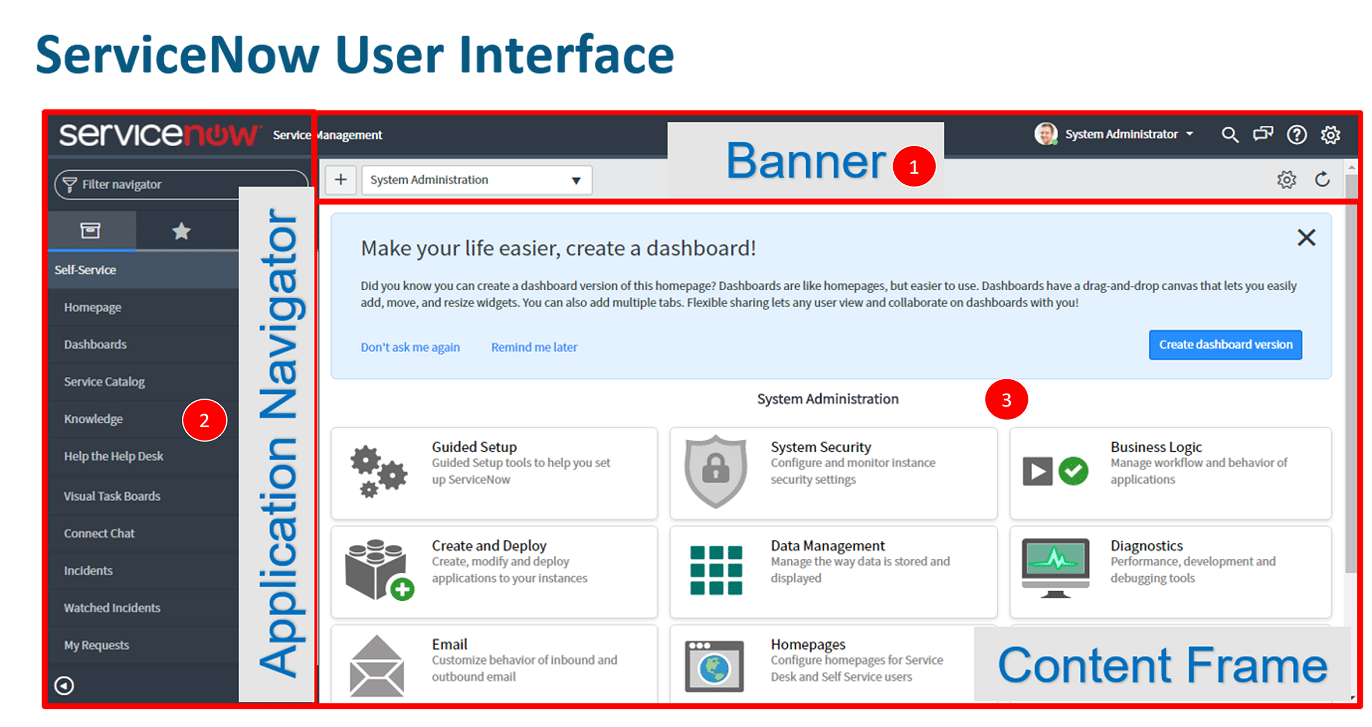
The ServiceNow User Interface is as shown below. We are logged in as System Administrator. Its main screen consists of the following three elements:

  1. Banner: This contains the ServiceNow Logo on the left top corner. On the right, you will find the Global Search Engine, Connectchat, Help Menu and Settings.
  2. Application Navigator: We have a list of the business applications and modules.
  3. Content frame: It consists of different data formats like Forms, Lists, etc.

The diagram below consists of the overview of the Administrator Homepage.

Image for post

Customization of UI

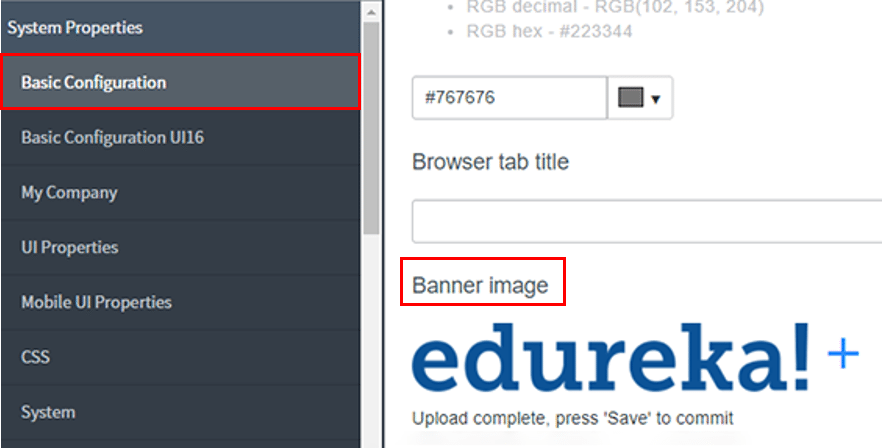
Moving ahead in this article let us see how we can customize the User Interface of our developer instance. A user with the admin role can make changes to the UI settings. By default, we use the UI 16 interface. Let me show you how to modify the caption text and add a Banner image.

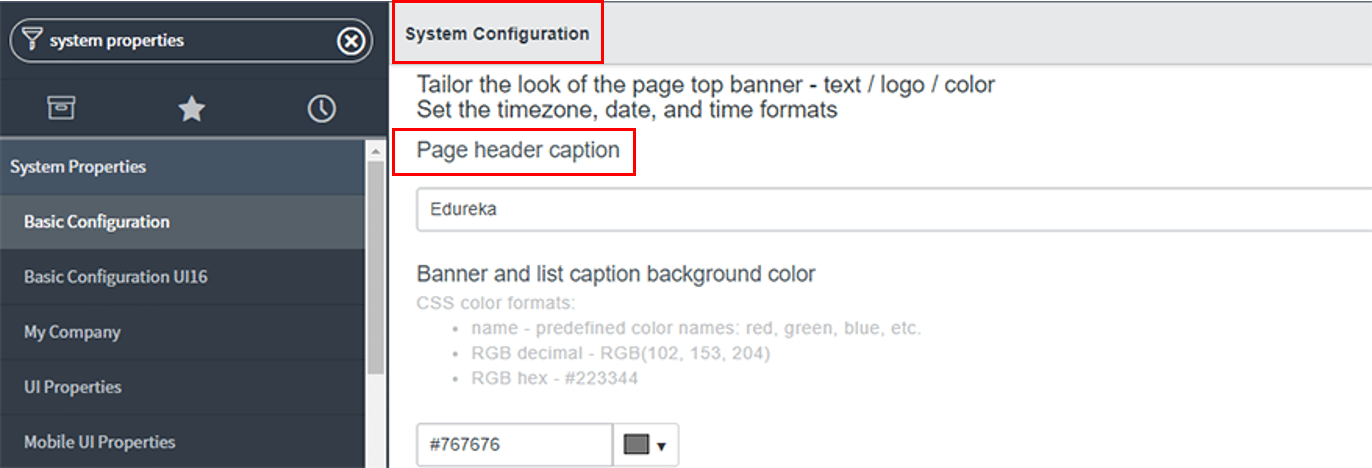
Step 1: Search for system properties. Look for basic configuration tab.

This gives you access to the system Configuration settings.

Image for post

Step 2: You can now set the Page header caption and also update the Banner image.

Image for post

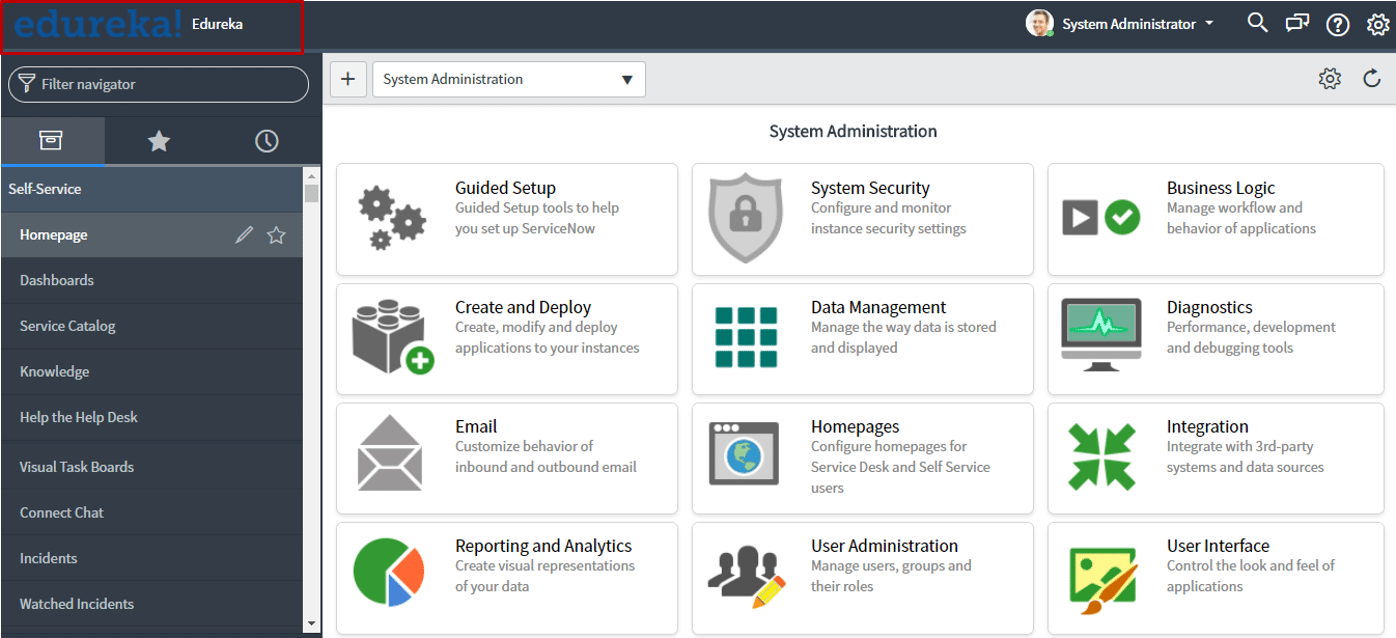
Below you will find the updated Banner image and header caption.

Image for post

Moving ahead, let us now learn how to create reports in ServiceNow.

Creating A Report

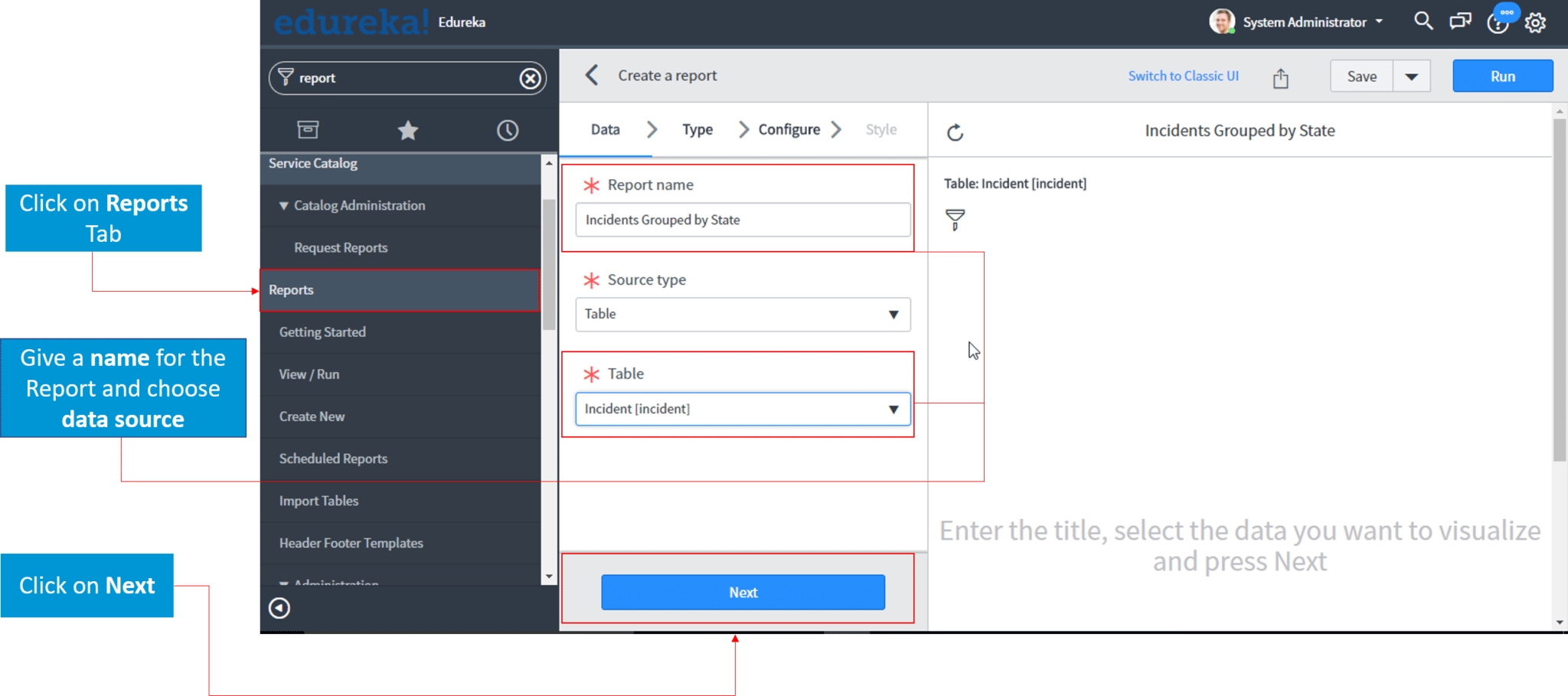
Step 1: We can create reports from an existing table or data source. In our example, we will generate a report from the existing Incident table which holds all Incidents.

Image for post

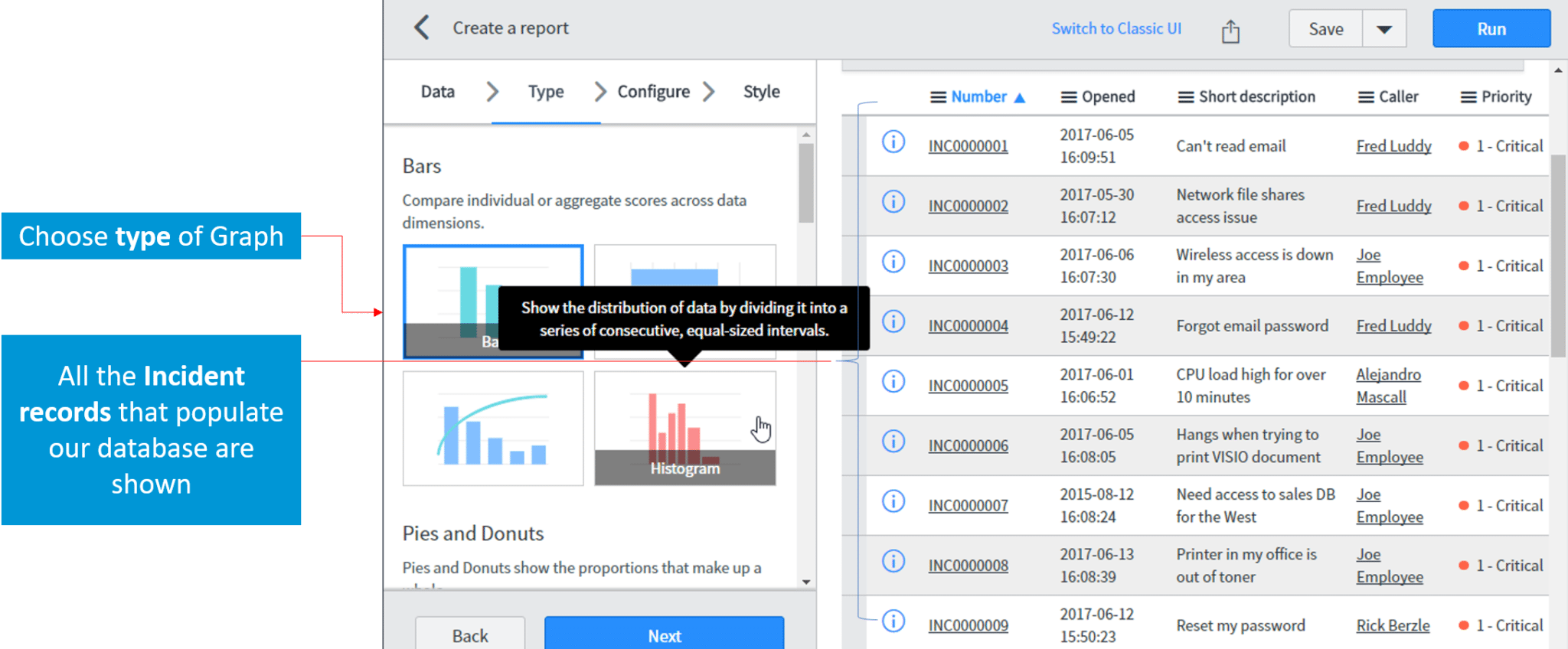
Step 2: To display our reports, we can choose from bar graphs, pie charts and a host of other options. In our example, we will choose the bar graph option.

Image for post

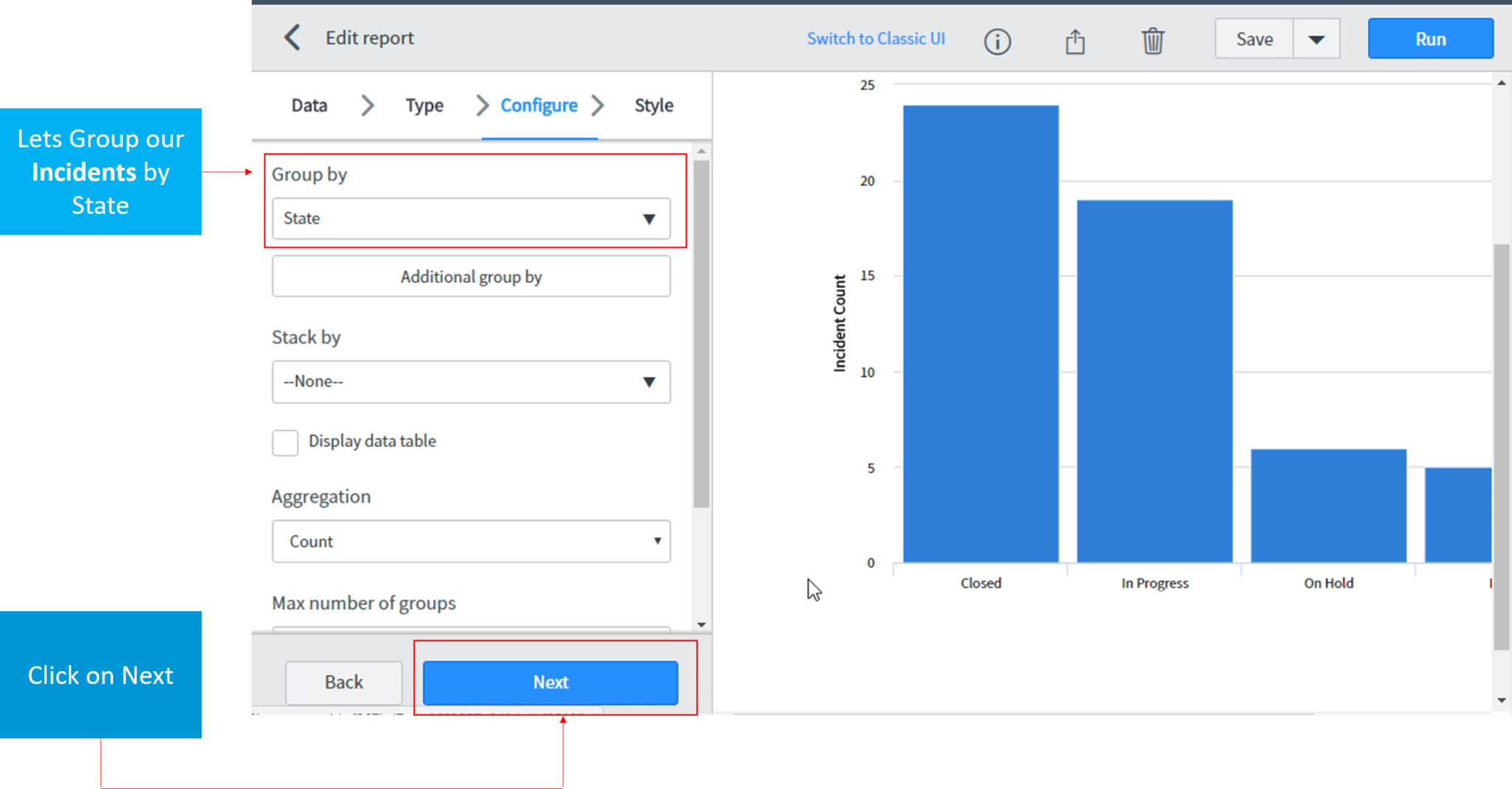
Step 3: We group our report according to the state parameter. This distributes the Incidents into open, in progress, closed and resolved states.

Image for post

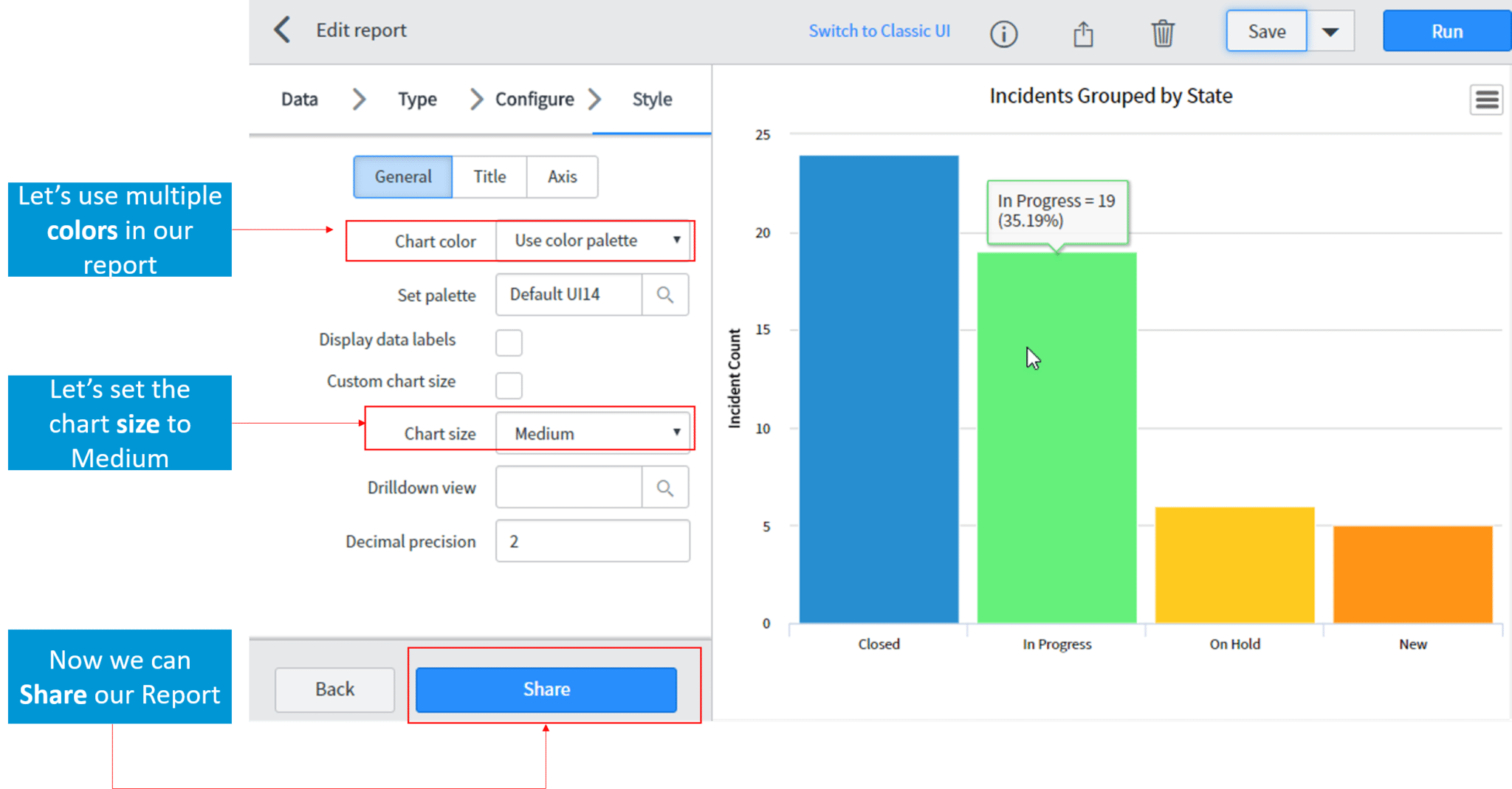
Step 4: We can customize the report according to our style requirements. Once generated, our report can be shared with other users and groups.

Image for post

Cool isn’t it? Now let us break down another neat feature of ServiceNow. One that we have already mentioned which is workflows.

Workflows

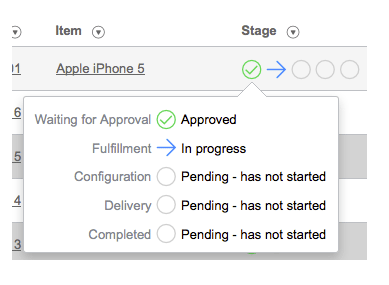
Workflows provide task progress. This can be seen in the stage field of the workflow. Workflows are used to assess each stage in a process and automate day to day tasks. This can be compared to Amazon order fulfillment. ServiceNow capitalized the lack of a major player in the ITSM field. This is just one of the examples of consumer like appeal that they bring to the table in ITSM.

The different stages of workflows in ServiceNow are as follows: Waiting for Approval, Fulfillment, Configuration, Delivery and Completed. Each stage denotes whether the task is In progress, Pending or Completed state. An assignee is automatically sent a reminder highlighting his task’s current progress.

Image for post
Workflows — What is ServiceNow?

This brings us to the end of this article. Hope this was informative and helpful to you.

If you wish to check out more articles on the market’s most trending technologies like big data ,servicenow online course,Cognos tm1,AI,DS,Java and etc visit OnlineITguru Training institute.

Common transform map for multiple data sources

  Overview Service-Now has a CMDB module which has almost all types of assets init. cmdb_ci is the base table for all assets. Same applies t...